

Views: 0 Author: Site Editor Publish Time: 2025-11-25 Origin: Site


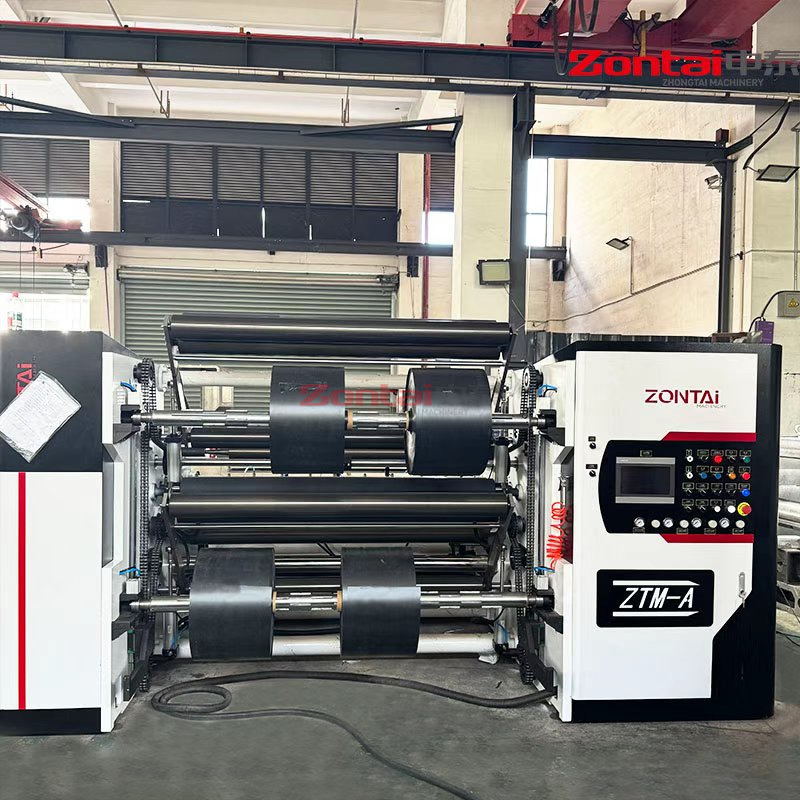
In today’s fast-moving manufacturing environment, production speed, accuracy, and consistency determine competitiveness. This is why many companies are now questioning whether sticking with manual systems is holding them back—especially when technologies like the automatic slitting and rewinding machine have become more advanced and accessible.
If your production relies on converting materials such as film, paper, foil, textiles, or laminates, upgrading to an automated Slitting Rewinding Machine may be one of the most impactful improvements you can make.
An automatic slitting and rewinding machine is a high-precision system that cuts large rolls of materials into narrower rolls and rewinds them into finished formats. Unlike manual or semi-automatic equipment, an automatic system handles most processes independently—from feeding and slitting to rewinding and tension control.
Slitting section with rotary or razor blades
Rewinding system with individual shafts or turret rewinding
Automatic tension control for consistent roll quality
Servo-driven motors for precise speed synchronization
Touchscreen control panel for parameter setting and monitoring
This combination ensures stable, efficient, and repeatable production, even at high speeds.
Investing in automation provides several measurable advantages.
Automatic systems operate faster and more consistently than manual machines. They reduce downtime caused by manual adjustments and can run continuously with minimal operator intervention.
The machine maintains consistent tension and blade pressure, ensuring smooth edges and uniform roll formation. This reduces material waste and improves downstream processing.
Although the initial investment is higher, manufacturers save significantly on:
labor costs
material waste
production errors
machine downtime
The longer the runtime, the faster the ROI.
Modern automatic machines adapt easily to different materials:
plastic films
paper
kraft
aluminum foil
non-woven fabrics
laminates
They allow quick changeovers, making them ideal for factories with diverse order requirements.
Manual Slitting Rewinding Machines require constant human input—adjusting tension, aligning blades, and monitoring rewinding. This limits production speed and increases inconsistency.
By contrast, automatic machines:
regulate speed and tension automatically
adjust blade alignment through servo systems
reduce operator fatigue
deliver consistent roll quality
Manual machines often require 2–3 operators. Automatic machines may require only one operator for supervision, reducing workforce pressure and long-term labor expenses.
Human error can lead to misalignment, wrinkles, or uneven edges. Automation minimizes these issues, improving product reliability and client satisfaction.
These machines play a crucial role in multiple industries:
Converting BOPP, PET, PVC, PE, and laminated films for food and industrial packaging.
Preparing roll materials for flexo, gravure, and digital printing processes.
Cutting kraft paper, coated paper, tissue logs, and adhesive labels.
Processing woven and non-woven fabrics for hygiene, medical, or industrial applications.
Slitting protective films, insulation materials, and specialty tapes.
Businesses should evaluate expected productivity growth and cost savings. Automatic systems typically pay for themselves quickly in high-volume settings.
Regular blade changes, lubrication, and tension calibration keep the machine in its best condition. Automated designs, however, require less frequent manual maintenance than older models.
Before purchasing, companies should assess:
available workshop space
material flow layout
compatibility with existing rewinding or packaging lines
Automatic machines can be integrated seamlessly into continuous production environments.
They highlight significant improvements in throughput and reduced waste when transitioning to automated slitting technology, especially for high-speed packaging materials.
This manufacturer emphasizes precise blade alignment and superior cutting accuracy that manual systems struggle to match. Their analysis shows reduced defect rates after automation.
According to their engineering team, automation is essential for scaling production with consistent quality. They stress reliability during long-run, 24/7 operations.
They point out that automatic systems enhance overall line efficiency, especially when integrated into larger automated factory setups.
Their specialists focus on quality repeatability, noting that automation produces stable, uniform rolls suitable for demanding downstream processes.
This machinery provider highlights reductions in downtime and operator workload. Their insights stress the importance of advanced tension control in modern production.
They report that automatic systems improve both speed and consistency, enabling manufacturers to take on larger orders without sacrificing precision.
Upgrading to an automatic slitting and rewinding machine is more than a simple equipment upgrade—it’s a strategic investment in productivity, consistency, and long-term profitability. Whether you work in packaging, printing, textiles, or industrial material conversion, automation provides measurable advantages that manual systems cannot match.
