

Views: 0 Author: Site Editor Publish Time: 2026-07-16 Origin: Site


Undetected print, coding, and material defects in high-speed packaging runs carry a compounding financial impact. A single registration error or compromised barrier property triggers product recalls, client rejections, and massive material waste. Relying solely on inline press inspection leaves operations vulnerable. High printing speeds, environmental variables, and continuous web motion allow micro-defects, web wrinkles, and edge damage to pass undetected into final child rolls. You cannot afford to ship flawed materials to your clients.
The solution lies in dedicated offline quality control. An Inspecting Rewinding Machine serves as the definitive post-print gateway. It isolates errors before they reach the converting or shipping stages. By investing in this offline technology, manufacturers guarantee defect-free output, perform critical roll doctoring, and protect operational margins from costly downstream failures.
Defect Elimination: Inspecting rewinding machines isolate and remove critical flaws—such as print registration errors, web wrinkles, splice problems, and coding errors—before final conversion, slitting, or shipping.
Specialized Substrate Handling: A dedicated flexible packaging inspection machine provides the precise tension control required for extensible films, labels, and laminates, preventing material distortion or stretching during the review process.
Offline Coding & Doctoring: Beyond inspection, these machines serve as offline platforms for high-speed inkjet batch coding, variable data printing (VDP), and roll correction (doctoring).
ROI Drivers: The equipment pays for itself by minimizing downstream machine downtime, reducing client chargebacks, and recovering usable material from otherwise rejected parent rolls.
Quality Assurance Compliance: Automated optical inspection (AOI) coupled with OCR/OCV technologies provides verifiable audit trails for strict industries (food, pharmaceutical, cosmetics).
The operational flow begins by unwinding the jumbo master roll. The web passes through a high-speed vision system before rewinding into high-quality child rolls under strictly controlled tension. This cycle forms the foundation of offline quality assurance. Operators rely on bidirectional capabilities for effective doctoring. The machine can reverse the web, isolate the exact defect, and allow for manual intervention. You splice out the bad section and resume operations without losing web alignment or compromising roll density. The unwind stand typically features shaftless chucks to handle heavy master rolls safely. Pneumatic brakes apply initial holdback tension. As the web travels through the machine, nip rollers isolate tension zones. This prevents the unwind tension from affecting the rewind tension. The rewind shaft uses differential friction rings or air shafts to build the finished roll. Taper tension profiles decrease the winding force as the roll diameter grows. This prevents inner layers from telescoping or starring under the weight of outer layers.
Modern inspection systems target specific anomalies that ruin packaging runs. These include missing print, color variations, inkjet coding errors, web wrinkles, edge damage, and faulty splices. The machine creates a comprehensive defect map of the entire roll. When it detects a flaw, the system synchronizes with the braking mechanism. It decelerates smoothly and places the exact defect directly at the splicing table. This precision eliminates the guesswork of finding errors manually within thousands of meters of film. The defect map acts as a digital twin of the physical roll. Operators view this map on the HMI screen. They can filter defects by size or type. For example, they might ignore pinholes under 0.1mm but stop for any registration shift over 0.5mm. The software logs the exact linear meter mark for every anomaly. This data allows the machine to run at maximum speed until it approaches a known defect. It then ramps down automatically, saving operator time and reducing material waste.
A doctoring rewinding machine plays a vital role in offline printing operations. It integrates thermal inkjet (TIJ) or continuous inkjet (CIJ) systems directly onto the web path. This setup allows you to apply batch codes, expiration dates, barcodes, and QR codes efficiently. The optical system verifies these codes in real-time. It checks for both legibility and sequence accuracy. If a barcode fails to scan or a batch number is smeared, the machine stops immediately, preventing unreadable data from reaching the consumer. Mounting the printheads on the rewinder offers distinct advantages over inline press mounting. The rewinder provides a stable, vibration-free platform. Encoders track the web speed precisely, ensuring the inkjet fires at the exact right millisecond. This prevents stretched or compressed text. You can also mount multiple printheads across the web width to code multiple lanes simultaneously. The verification camera sits immediately downstream of the printheads. It uses OCR (Optical Character Recognition) to read the text and OCV (Optical Character Verification) to grade the print quality against ISO standards.
Press-mounted cameras are insufficient for final quality assurance. Inline systems face severe vibration and speed constraints. When a defect occurs on the press, operators cannot easily remove it without stopping the entire printing operation. Stopping a press ruins the current print run and generates massive setup waste. Furthermore, printing presses lack the specialized rewind tensioning required to fix poorly wound rolls. Offline inspection decouples quality control from production speed, allowing thorough review without bottlenecking the press. Consider the thermal dynamics of a printing press. Dryers blast the web with hot air. Chill rollers shock it cold. These temperature swings cause the film to expand and contract. Inspecting the web under these conditions leads to false registration errors. An offline machine inspects the film after it has stabilized at room temperature. This provides a true representation of the final product. Additionally, press operators focus on ink viscosity, color matching, and impression pressure. They do not have the bandwidth to monitor a defect screen continuously. Dedicated inspection operators catch subtle flaws that press operators miss.
Handling thin, extensible materials requires specialized equipment. A flexible packaging inspection machine manages the physics of BOPP, PET, and PE films alongside self-adhesive labels, aluminum foils, and thermal papers. Each substrate reacts differently to tension. Closed-loop tension control is necessary to prevent film stretching, telescoping, or uneven roll edges during the rewinding process. Without precise tension management, the inspection process itself could damage the material, rendering the roll useless for high-speed packaging lines. Polyethylene (PE) stretches easily under minimal load. If you pull it too hard, the printed images distort. The web necks-in, becoming narrower. Aluminum foil, conversely, has zero stretch. If you apply uneven tension, it snaps instantly. The rewinder must adapt to these extremes. Operators select pre-programmed tension recipes based on the material type and thickness. The machine adjusts the PID loop gains automatically. This ensures the dancer arms remain stable and the load cells report accurate feedback, regardless of what substrate runs through the machine.
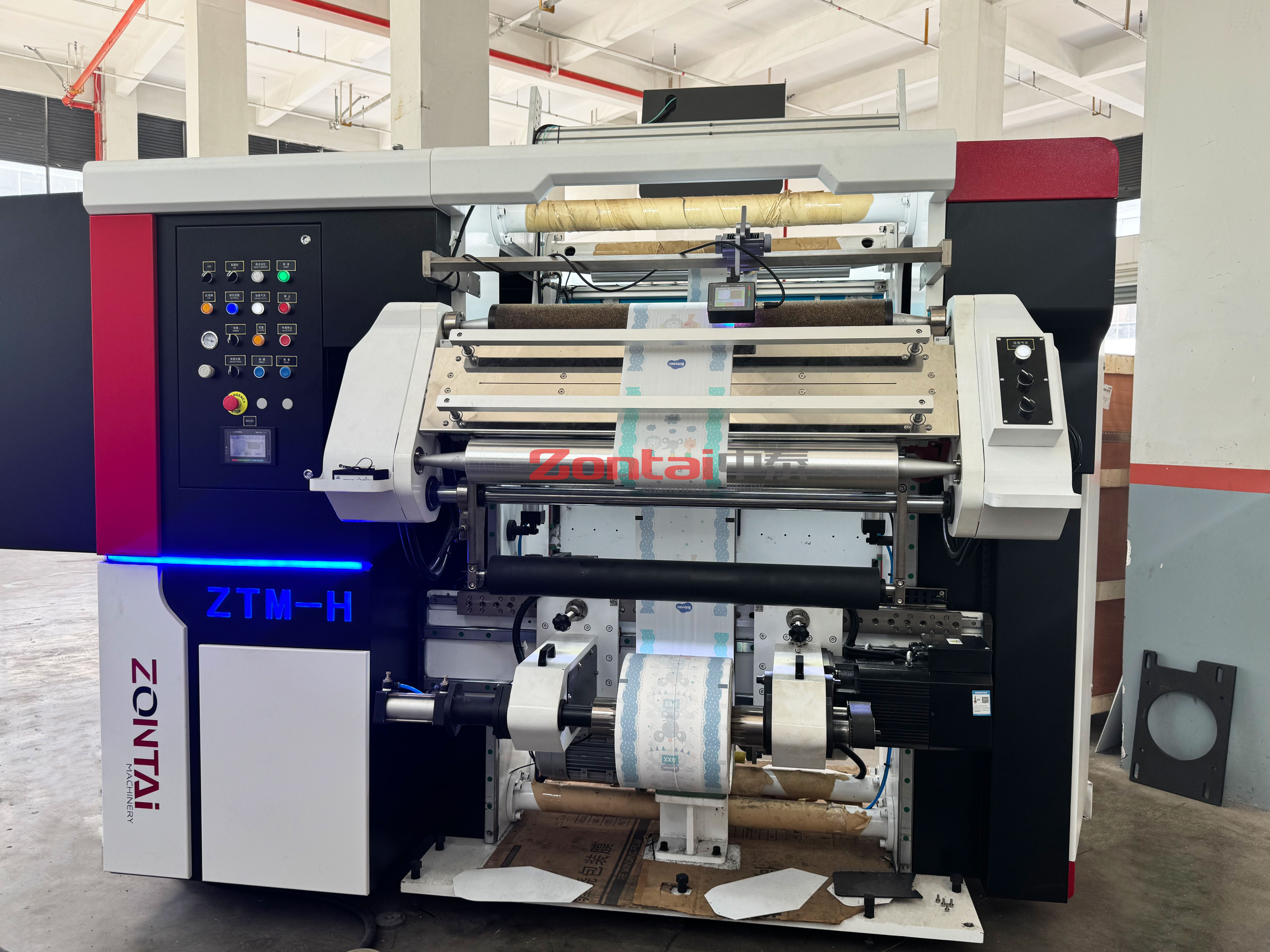
Automated optical inspection (AOI) provides 100% surface coverage, unlike stroboscopic sampling which only checks intermittent frames. High-resolution line-scan cameras and advanced software algorithms detect micro-defects at extreme web speeds. Optical Character Recognition (OCR) and Optical Character Verification (OCV) features validate offline printed batch numbers and barcodes. These systems compare the live web against a golden master PDF. Any deviation triggers an immediate alert, ensuring absolute fidelity to the approved artwork. Lighting plays a massive role in defect detection. Coaxial lighting highlights surface scratches and foil pinholes. Backlighting reveals uneven adhesive coating or missing opaque white ink. The vision system must control these light sources precisely. The software uses blob analysis to measure the size of a defect. It uses edge detection to check registration marks. Machine learning algorithms now help classify defects. The system learns the difference between a harmless dust particle and a critical doctor blade streak. This reduces false positives and keeps the machine running efficiently.
High-precision web handling relies on several critical components. Load cells measure web tension continuously. Dancer rollers absorb sudden tension spikes. Powder brakes or servo motors adjust the unwind and rewind force dynamically. Ultrasonic edge sensors keep the web perfectly aligned. These components work together to ensure the finished child roll is wound to the correct density. A properly tensioned roll prevents telescoping and feeds flawlessly into downstream slitting or pouch-making equipment. The web guide system deserves special attention. It consists of a sensor, a controller, and an actuator. The sensor detects the edge of the web or a printed line. The controller calculates the error. The actuator shifts the entire unwind stand or a pivoting roller frame to correct the alignment. This happens in milliseconds. Without accurate web guiding, the printed lanes wander. The vision system loses its reference points. The final roll develops uneven edges, causing jams in the packaging machines.
Feature | Inline Press Inspection | Offline Inspecting Rewinding Machine |
|---|---|---|
Defect Removal | Requires stopping the press (high waste) | Seamless removal at splicing table |
Tension Correction | Limited to press capabilities | Dedicated closed-loop tension control |
Production Speed Impact | Slows down primary printing operations | Zero impact on press throughput |
Variable Data Integration | Complex and prone to press vibration errors | Stable platform for TIJ/CIJ coding |
Lighting Control | Fixed, compromised by press geometry | Optimized coaxial and backlighting |
Roll Density Management | Basic surface winding | Advanced center-surface winding with taper |
The splicing table is the operational heart of defect removal. Ergonomic and mechanical features directly impact throughput. Pneumatic clamps hold the web securely in place. Specialized underlight inspection windows illuminate the material, making it easy to see registration marks. Cutting guides ensure perfectly straight edges. These features allow operators to cut out defective material quickly and create a seamless, high-strength splice. Efficient splicing minimizes machine downtime and maintains the structural integrity of the web. You have two main splice types: overlap and butt splice. Overlap splices are fast but create a thick bump in the web. This bump can damage printheads or jam packaging formers. Butt splices join the two web ends edge-to-edge using tape on one or both sides. This creates a smooth transition. The splice table must support both methods. Vacuum tables hold the web perfectly flat during the cut. Built-in tape dispensers speed up the process. A good operator can complete a flawless butt splice in under thirty seconds.
Salvaging large industrial rolls creates immediate value. Instead of scrapping an entire web due to a localized printing error, you remove only the defective section. This targeted waste removal recovers thousands of meters of usable material. Furthermore, feeding guaranteed defect-free, properly wound rolls into slitting, pouch-making, or filling stages drastically reduces downtime. Downstream machines run faster and jam less frequently when processing perfect rolls. Consider the cost of a jammed pouch-making machine. You lose the material in the machine. You lose the production time to clear the jam. You lose the time to re-thread the web. You risk damaging the sealing jaws. By catching a faulty splice or a wrinkled web section on the rewinder, you prevent this entire chain of losses. The rewinder acts as an insurance policy for your most expensive converting assets. It ensures they only process material that yields sellable products.
This machine functions as an indispensable compliance tool. ISO standards, food safety regulations, and pharmaceutical packaging requirements demand strict quality control. You provide clients with automated inspection reports proving roll quality and batch-code integrity. These audit trails build trust and secure long-term contracts. Preventing a single major product recall or client chargeback often covers the entire capital investment of the machine. Pharmaceutical clients require 100% verification of every printed character. A missing decimal point in a dosage instruction causes catastrophic harm. The rewinder's vision system logs every inspected frame. It generates a PDF report detailing the exact location and nature of any removed defects. You hand this report to the client alongside the finished rolls. This level of transparency differentiates your operation from competitors who rely on manual spot checks.
Operators must balance running the machine at maximum speed against the camera's ability to process high-resolution data. Pushing the speed too high causes the vision system to miss micro-defects. You determine the optimal running speed based on material type, print complexity, and defect tolerance. High-contrast, simple designs run faster. Complex, low-contrast pharmaceutical labels require slower speeds to ensure the OCR/OCV algorithms function with absolute accuracy. Camera resolution dictates the minimum detectable defect size. A 4K line-scan camera covering a 1000mm web yields a pixel resolution of 0.25mm. To detect a 0.1mm pinhole, you need an 8K camera or multiple 4K cameras mounted side-by-side. Processing this massive amount of image data requires powerful industrial PCs. If the web speed exceeds the PC's processing frame rate, the system drops frames. Uninspected material slips through. You must establish standard operating procedures (SOPs) that dictate the maximum allowable speed for each specific job profile.
Setting up inspection parameters involves a learning curve. Operators define tolerances for acceptable color variation versus critical defects. Improper calibration leads to false positives. If the vision system is too sensitive, it triggers unnecessary machine stops. This causes operator fatigue and severely reduces throughput. Proper training ensures your team fine-tunes the algorithms, maximizing defect detection while maintaining efficient production speeds. Training should focus on recipe management. Operators must learn how to create a golden template from a known good section of the web. They need to understand how to mask out areas that naturally vary, like clear windows or variable data zones. They must learn to adjust the sensitivity thresholds for different defect categories. A color shift might have a high tolerance, while a barcode defect has zero tolerance. Regular refresher courses keep operators sharp and prevent them from bypassing the system out of frustration.
Integrating this equipment requires careful floor space planning. The machine typically sits between the primary printing press and the final slitting or converting line. Workflow logistics must accommodate the movement of heavy jumbo rolls. Maintenance realities require daily attention. You keep camera lenses and sensors clean in dusty environments. Calibrating tension sensors and servicing pneumatic and braking components ensures long-term reliability and prevents web handling issues. You need adequate clearance around the machine for roll handling equipment, like overhead cranes or pallet jacks. You need clean, dry compressed air for the pneumatic chucks and splice table clamps. You need isolated power drops to prevent electrical noise from interfering with the vision system PCs. Daily maintenance includes wiping down the idler rollers with isopropyl alcohol to remove ink buildup. Weekly maintenance involves checking the load cell calibration with certified weights. Monthly maintenance includes inspecting the powder brakes for wear and replacing the friction powder if necessary.
An inspecting rewinding machine is a critical quality-gate and revenue-protection tool for packaging converters competing on precision, speed, and reliability. By isolating defects offline, you protect your primary press throughput and guarantee flawless deliveries to your clients. When evaluating vendors, prioritize vision system integration, specifically AOI and OCR/OCV capabilities. Scrutinize the tension control precision for your specific substrates, whether handling extensible films, delicate foils, or self-adhesive labels. Ensure the manufacturer provides robust local technical support to assist with system calibration and operator training.
Audit your current waste metrics to identify material lost to undetected inline printing errors.
Calculate the financial impact of recent client rejections or downstream machine downtime.
Schedule a material test and demonstration with an equipment manufacturer using your most challenging substrates.
Define your specific OCR/OCV requirements based on your clients' compliance standards.
Map out your floor space and utility drops to ensure seamless integration into your existing workflow.
A: Standard slitters focus on cutting wide webs into narrower rolls. Inspection rewinders focus on 100% surface inspection, defect removal, and bidirectional web control without necessarily slitting the material.
A: Doctoring machines repair poorly wound rolls. They integrate offline inkjet coding and verification systems to apply variable data, lot numbers, or barcodes directly to the web during the rewind process.
A: Yes. Advanced, multi-substrate tension control systems allow a single machine to handle varying substrates, from rigid papers and laminates to highly extensible polymer films and self-adhesive labels, provided the load cells are properly calibrated.
A: The camera detects the flaw, and the machine decelerates. It reverses if necessary and stops with the defect positioned exactly at the splicing table for manual or semi-automated removal.
A: Mechanical speeds exceed 300 to 400 meters per minute. However, actual operational speed is dictated by the vision system's processing power, the resolution required, and the complexity of the printed design.
A: High-speed line-scan cameras capture continuous images of the web. The system compares these images in real-time against a golden master PDF or reference image to flag deviations and defects instantly.
A: Regular optical cleaning, software updates, and load cell calibration are essential. You inspect mechanical wear parts like rollers, static eliminators, and brakes to maintain accuracy and prevent web damage.
