

Views: 0 Author: Site Editor Publish Time: 2026-06-10 Origin: Site


For converters and manufacturers, the true cost of a slitting setup isn't the initial capital expenditure. Instead, it is the ongoing scrap rate driven by unseen physical forces. Material thickness variations and high-speed processing create dynamic physical forces inside the equipment. Without precise tension control, webs stretch uncontrollably, cores crush under heavy pressure, and finished rolls telescope during transit. The resulting defects erode profit margins and destroy production schedules silently.
Evaluating the tension control architecture remains the most critical step when shortlisting a Slitting Rewinding Machine. Buyers must look beyond surface-level specifications to understand how the equipment handles complex material behaviors. This guide breaks down the financial impact, system types, and operational realities of modern tension management.
Precise tension control directly dictates finished roll quality, minimizing defects like telescoping, wrinkles, and web breaks.
Effective systems partition control into three distinct zones: Unwind (proportional torque), Slitting (constant tension), and Rewind (taper tension).
Material thickness inconsistencies (caliper variations) require differential friction shafts to maintain uniform tension across multiple slit rolls.
Selecting between mechanical, pneumatic, and closed-loop servo systems depends entirely on material extensibility (e.g., rigid paper vs. <12μm BOPP) and desired processing speed.
Uncontrolled tension directly impacts your bottom line. We must translate common web defects into hard financial losses. Production environments face two primary failure modes: under-tension and over-tension. Each state triggers specific mechanical failures across the production line.
Under-tension: Material lacks sufficient pull across the rollers. The web wanders laterally across the mechanical path. You experience poor slit edge quality immediately. Finished rolls often telescope during transit because loose material layers slide against each other freely.
Over-tension: The machine pulls the web excessively. This causes permanent material elongation, known mechanically as yielding. Heavy compressive forces crush internal paper cores. Web breaks occur frequently under high stress. These sudden breaks force costly machine downtime while operators rethread the entire system manually.
High-tier control architectures reduce edge trim waste significantly. They eliminate the frustrating need to quarantine rejected products. Operators no longer waste valuable hours reworking spongy or dished rolls. Automated algorithms also protect your throughput efficiency. They prevent operators from slowing down the equipment just to manually stabilize a vibrating web. Factory floors achieve maximum output speeds when systems handle dynamic physical forces automatically. You secure higher production yields when tension parameters remain perfectly stable from the very first meter to the last.
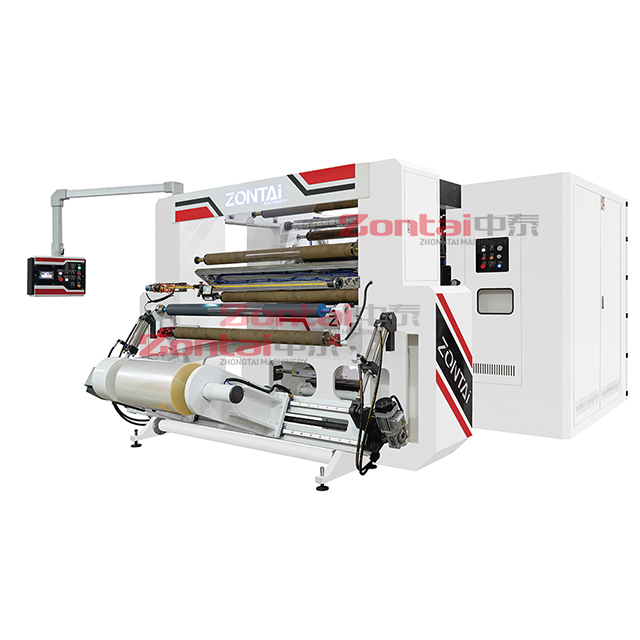
Buyers must verify specific subsystem capabilities during equipment selection. A reliable machine never treats tension globally. Instead, it isolates pulling forces across three distinct operational zones. We evaluate each zone based on its specific physical requirements and dynamic behavior.
Zone 1: Unwind Control (Master Roll)
The primary unwinding station requires continuous dynamic torque reduction. The jumbo roll's overall diameter decreases constantly during high-speed operation. Braking torque must decrease proportionally to match this shrinking radius. Failing to drop braking torque causes massive tension spikes. The system must adapt instantly to prevent web snapping or stretching.
Zone 2: Slitting/Draw Zone (Web Transport)
This middle section requires absolute constant tension. The web must remain perfectly flat and stable here. Any minor fluctuation causes the material to wander just before reaching the cutting knives. Lateral wandering creates out-of-spec roll widths. Reject rates climb rapidly when draw zones fluctuate unpredictably.
Zone 3: Rewind Control (Finished Rolls)
The final stage must feature advanced taper tension capability. Tension must intentionally decrease as the rewound roll grows larger. We call this the "inner tight, outer loose" principle. It prevents heavy outer layers from crushing the internal cardboard core. It also eliminates starring defects visible on the finished roll's side profile.
Modern processing demands this exact spatial partitioning. Mixing these zones leads to catastrophic material failure. Each section requires dedicated sensors, dedicated rollers, and independent drive mechanisms to function correctly.
Physical realities dictate complex processing challenges. No web material features perfectly uniform thickness across its entire width. We observe microscopic caliper variations daily. These tiny thickness inconsistencies mean adjacent slit rolls grow at slightly different overall diameters. A one-micron difference compounds drastically over thousands of continuous wraps.
You must understand the diameter and tension collapse phenomenon. Physics dictates a simple rule: Tension equals torque divided by radius. Rolls holding slightly larger diameters will suddenly hog all available tension. They pull aggressively against the incoming web. Adjacent smaller rolls remain completely loose and unspooled. This dynamic destroys batch consistency instantly.
The engineering solution lies in differential winding technology. Evaluate equipment utilizing differential friction shafts. You will encounter core-slip or core-lock designs in the field. These specialized shafts run at a slight over-speed, typically ranging between 1% and 3%. They use internal pneumatic friction rings to manage mechanical drag. This intelligent design allows individual rolls to slip independently along the shaft. The mechanism maintains uniform tension despite obvious diameter differences across multiple slit rolls.
We constantly remind buyers to respect the TNT principle. Optimal wound roll structure relies entirely on three balanced elements. You must balance Tension, Nip pressure, and Torque simultaneously. Differential shafts manage the torque variable perfectly. They protect delicate materials from uneven pulling forces across the entire production run.
Your hardware decision framework must match your factory's primary material mix. Processing speed requirements also dictate ideal hardware choices. We categorize braking and drive architectures into three primary performance tiers.
System Type | Best Application Match | Core Control Mechanism | Primary Limitations |
|---|---|---|---|
Mechanical / Magnetic Particle | Budget setups, slow speeds, rigid materials (paper, thick laminates). | Uses physical friction brakes or magnetic particle clutches to resist unspooling. | Generates high friction heat. Suffers from much slower response times. |
Pneumatic Control Systems | Mid-range production floors requiring stable, reliable daily output. | Air pressure regulates mechanical braking force dynamically via proportional valves. | Air supply fluctuations can occasionally alter precise tension settings unexpectedly. |
Closed-Loop Servo Motor | High-speed operations (>600m/min), extensible films (<15μm PET/BOPP). | Load cells measure direct physical tension, feeding PID algorithms for millisecond servo adjustments. | Requires higher initial capital expenditure. Needs properly trained machine operators. |
Closed-loop servo architectures represent the global industry gold standard. They utilize highly sensitive load cells mounted on specific guide rollers. These advanced sensors capture direct tension measurements continuously. The hardware feeds real-time data into the Programmable Logic Controller (PLC). The system executes sophisticated PID algorithms instantly. It applies millisecond servo adjustments to correct microscopic web deviations. This seamless integration delivers the lowest possible scrap rate for high-value optical films. A top-tier Slitting Rewinding Machine invariably employs closed-loop servo drives for its critical draw and rewind zones.
Factory installations always expose complex subsystem interactions. Tension control and Edge Position Control (EPC) interact heavily during normal operation. We highlight this interaction as a major implementation risk. A sudden EPC correction alters the exact wrap angle across the rollers. This sudden geometrical shift spikes local tension immediately. The internal PLC must coordinate these two subsystems seamlessly. It prevents one rapid correction from triggering a secondary mechanical failure.
Operators must establish material-specific parameter baselines quickly. Hands-on expertise drives these critical initial settings. You must adjust starting tensions based on specific material elasticity and overall thickness profiles.
Thin Optical Films (e.g., 12-25μm PET): These materials require delicate handling. Set your Unwind zone lightly between 10-25N. Configure the Rewind zone carefully for 15-30N. You must apply aggressive taper tension here. Drop the tension profile steeply from 100% down to 50% as the roll grows. This prevents intense internal pressure from crushing inner layers.
Thick or Rigid Films (e.g., 60-100μm PE): These heavy materials demand aggressive control forces. Unwind settings should land firmly between 40-80N. Rewind settings need 50-100N. Taper tension remains intentionally mild. You might drop from 100% to only 80%. This prevents thick, heavy materials from wandering laterally across the winding drum.
Daily operator adoption dictates long-term equipment success. Emphasize saving proven material recipes directly into the Human Machine Interface (HMI). Digital parameter recipes remove daily operator guesswork completely. They guarantee repeatable production quality across multiple shift changes and varying operator skill levels.
Tension management transforms a basic web transport device into a precision quality-assurance tool. It ultimately dictates the structural integrity of every finished roll leaving your facility. We strongly advise against compromising on closed-loop feedback systems. Always specify differential rewinding shafts if processing thin, highly extensible, or high-value materials. These dedicated technologies protect your production yield aggressively against microscopic material flaws.
Encourage your procurement team to request a comprehensive material trial before finalizing any purchase. Supplying your own jumbo roll for live testing provides the only verifiable proof available. It guarantees the manufacturer's algorithms and mechanical hardware can handle your specific substrates flawlessly.
A: A programmed decrease in winding tension as the roll diameter increases, preventing outer layers from crushing inner layers.
A: Open-loop estimates tension based on roll diameter (usually via ultrasonic sensors), while closed-loop measures actual physical tension in real-time using load cells or dancer rolls.
A: This is a classic symptom of inadequate tension control (specifically poor taper tension) combined with a lack of proper web guiding or differential slipping.
