

Views: 0 Author: Site Editor Publish Time: 2026-07-24 Origin: Site


In web converting, packaging, and printing operations, equipment misalignments directly impact throughput and scrap rates. Selecting the wrong roll-to-roll processing machinery creates permanent production bottlenecks on the floor. Facility managers and production engineers often conflate the capabilities of web sizing equipment with quality control equipment. Relying on a slitting rewinding machine for primary quality assurance or an Inspecting Rewinding Machine for high-volume roll division leads to compromised tension control, undetected defects, and inefficient capital deployment. This guide provides a technical framework to differentiate between these two distinct machine types. We evaluate their mechanical functions, terminology nuances, and ideal use cases to inform your next procurement cycle. You will learn how to align machinery capabilities with specific production targets, ensuring optimal web handling and defect management without unnecessary downtime.
Functional Divergence: Slitting machines are engineered primarily for dimensional formatting (dividing wide master rolls into narrower rolls), whereas an inspecting rewinding machine is purpose-built for defect detection, removal, and web salvage.
Quality Control Limitations: Traditional slitting relies on operator visual checks—prone to fatigue and error—while dedicated inspecting rewinders utilize 100% automated vision systems for high-compliance validation.
Terminology Clarity: "Slitting" refers to the dividing process, "rewinding" refers to winding material onto a new core with controlled tension, and "slitting rewinding" combines both. An inspecting rewinder adds a dedicated vision system and stop-on-defect synchronization.
Investment Strategy: Choosing between the two—or opting for a hybrid automatic detection, slitting, and rewinding machine—depends on a strict evaluation of throughput requirements versus acceptable defect tolerances.
Understanding web processing requires precise terminology on the shop floor. Operators and engineers often use terms interchangeably, causing confusion during equipment specification. We must separate the physical actions applied to the web to ensure accurate machinery selection.
Slitting: The physical process of dividing a wide master web into narrower widths. This process utilizes shear, razor, or score blades running parallel to the web direction.
Rewinding: The process of winding a loose web of material onto a new, tightly controlled core. This achieves specific roll density, edge alignment, and hardness profiles necessary for downstream packaging.
Cutting: Transverse separation. This means shearing across the web width, as opposed to longitudinal slitting along the web length.
A slitting machine executes a specific mechanical objective. It unwinds a master roll, passes the web through a cutting section, and rewinds it onto multiple narrower cores simultaneously. The primary goal is dimensional reduction at high speeds. These machines focus heavily on web tension isolation. They utilize edge guiding systems to keep the master roll aligned before it hits the blades. Differential shaft winding is a critical component here. Because a single master roll has slight thickness variations across its width, the resulting narrow rolls will build up at different diameters. Differential shafts slip independently to maintain uniform tension on every individual slit roll. The entire architecture prioritizes high-speed continuous output.
When running a slitter, operators monitor the shear knives or razor blades for wear. Dull blades cause dusty edges or micro-tears in the film. The nip rollers must maintain consistent pressure to isolate the unwind tension from the rewind tension. If the isolation fails, the slit rolls will interweave or telescope. The machine design assumes the incoming master roll is already free of major print or coating defects. The focus remains entirely on converting a wide format into a narrow format as quickly as possible.
The mechanical objective of an inspecting rewinding machine differs entirely. It unwinds a roll, passes it over an inspection table or through an automated vision system, and rewinds it onto a single core. It does not divide the web into narrower lanes. This equipment focuses on bidirectional web control. Operators need precise stopping capabilities for defect splicing. When the system detects a fault, the machine decelerates rapidly, maps the fault, and often reverses the web to place the defect exactly on a splice table. The tension system must accomplish this without stretching the material. It guarantees zero damage to fragile print or substrates without altering the web's original width.
These machines utilize low-inertia rollers and highly responsive servo motors. When a defect is flagged, the web must stop within milliseconds. The reversing process requires the rewind shaft to act as an unwind, and the unwind shaft to act as a rewind. This bidirectional tension control is complex. Load cells constantly feed data back to the PLC to adjust motor torque. If the tension spikes during a reversal, extensible films will stretch, ruining the print registration. If the tension drops, the web will wander off the edge guide.
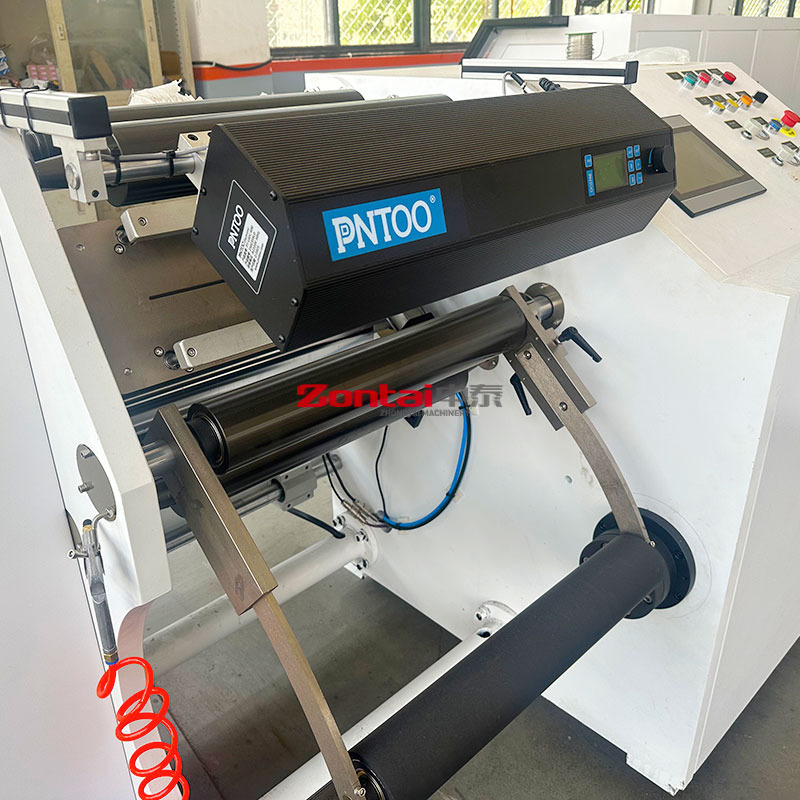
You measure the success of these machines using different criteria. A slitting machine is measured by cut edge quality, slit width tolerance, and roll profile uniformity. If the narrow rolls are straight, hard, and dimensionally accurate, the machine performs well. An inspecting rewinding machine is measured by defect capture rate, splice integrity, and waste minimization. Success means no defective material reaches your customer. The focus shifts from volume output to strict quality compliance.
Feature | Slitting Machine | Inspecting Rewinding Machine |
|---|---|---|
Primary Function | Dimensional formatting (wide to narrow) | Quality assurance and defect removal |
Web Division | Divides into multiple rolls | Maintains single web width |
Tension System | Differential friction shafts | Low-inertia, bidirectional control |
Operating Speed | Continuous, high speed (300-800+ m/min) | Variable, frequent stops and reversals |
Success Metric | Roll profile and slit accuracy | Defect capture and splice quality |
Operator Focus | Blade setup and core alignment | Defect classification and splicing |
Tension zones dictate machine design. Slitters require complex differential rewinding shafts. They handle caliper variations across multiple narrow rolls simultaneously. If one roll builds up faster than its neighbor, the differential shaft compensates to prevent web breaks or loose winding. The friction rings on the shaft slip at different rates based on the diameter of the individual roll. This requires precise pneumatic control and regular maintenance to ensure the friction rings do not glaze over or lock up.
Inspecting rewinders require highly responsive, low-inertia tension systems. They must handle rapid deceleration, reversing, and re-acceleration. When a camera flags a defect, the machine stops immediately. The web then reverses to the splice table. The tension system must maintain perfect control during this bidirectional movement without stretching or scratching the substrate. Driven idler rollers and closed-loop load cells are standard requirements here. The servo drives must communicate instantly to prevent web slack. Any slack during a reversal will cause the web to snap when the machine accelerates forward again.
Operational speeds highlight the divergent use cases. Slitting machines run at high, continuous speeds. They often operate between 300 to 800 meters per minute to maximize volume. Stopping a slitter is highly undesirable. Every stop increases the risk of tension loss across the differential shafts. Operators aim to load a master roll, thread the machine, and run the entire roll without interruption.
Inspecting rewinders operate variably. They slow down or stop entirely when the automated detection system flags an anomaly. Human-led splicing takes time. The operator must cut out the defect, align the two web ends on the splice table, apply splicing tape, and verify the joint. Therefore, an inspecting rewinder will always have a lower total throughput compared to a continuous slitter. You trade sheer speed for guaranteed quality. Production planners must account for this variable throughput when scheduling jobs.
Slitting machines dominate specific sectors. They are ideal for high-volume flexible packaging, paper converting, and basic film manufacturing. In these environments, dimensional reduction is the sole or dominant requirement. You take a master roll from a printing press or extruder and format it for the final packaging line. If your primary goal is turning one large roll into ten small rolls for a flow-wrapping machine, a slitter is the correct choice. The mechanical design supports continuous, heavy-duty operation.
Consider a facility producing standard snack food wrappers. The printing press outputs a massive master roll. The slitter takes this roll and cuts it into individual lanes for the form-fill-seal machines. The defect tolerance is relatively high, and the primary bottleneck is sheer volume. A high-speed slitter maximizes output and keeps the downstream packaging lines fed with material.
Relying on a slitter for quality control introduces severe risks. Traditional slitting relies on the human eye. At speeds exceeding 300 meters per minute, operators suffer from visual fatigue. They cannot reliably spot micro-defects, color shifts, or missing print registers. A strobe light can help freeze the image, but the operator still cannot catch every error across a wide web.
Furthermore, stopping a slitter to remove a defect disrupts the tension of all other slit lanes. If you stop to cut out a bad section on lane three, lanes one, two, and four lose their winding tension. This often ruins the entire set of rolls across the shaft. It generates high volumes of waste and destroys production efficiency. Slitters are simply not built for frequent stopping and splicing. Attempting to use them as inspection devices leads to massive scrap rates and frustrated operators.
Certain industries operate under zero-defect mandates. Pharmaceutical packaging, medical devices, security printing, and premium prime labels require strict compliance. A single defect in a pharmaceutical label results in client rejection and severe financial penalties. In these applications, an inspecting rewinding machine is mandatory. It acts as the final gatekeeper. It ensures that every millimeter of the web meets strict quality standards before it moves to the next converting stage or ships to the end user.
For example, printing lot numbers and expiration dates on medical packaging requires 100% verification. A missing digit can cause a product recall. The inspecting rewinder scans every single character. If a digit is missing or illegible, the machine stops, brings the exact error to the operator, and forces a correction. This level of control is impossible on a standard slitter.
Modern inspecting rewinders rely on advanced technology. There is a powerful synergy between the machine and 100% inspection cameras, often called Automated Vision Systems (AVS). The camera scans the web and compares it to a master PDF. The system uses high-intensity LED lighting to illuminate the web, capturing high-resolution images at full line speed.
When a deviation occurs, the system triggers the machine. Features like automated fault placement bring the defect exactly to the splice table. The operator does not have to search for the error. The system also creates digital roll mapping. This provides a complete quality report for the specific roll, proving compliance to your clients. The roll map shows the exact linear footage of every splice and accepted defect, giving the end-user confidence in the material.
Inspecting rewinders also function as excellent salvage tools. Sometimes, previous processes create "telescoped" rolls or uneven winding. You can run these compromised rolls through an inspecting rewinder to correct tension issues and rewind them into perfect, usable rolls. The edge guide system will realign the web, and the closed-loop tension control will build a solid roll profile.
You can also remove flagged defects from master rolls before they reach downstream processing steps. Salvaging expensive substrates directly improves your material yield and reduces overall scrap rates. Instead of throwing away an entire roll due to a few bad meters, you cut out the bad sections and save the rest of the material. This salvage capability often pays for the machine within the first year of operation.
Equipment manufacturers offer 3-in-1 hybrid machines. These combine high-speed slitting with automated defect detection systems. While appealing in theory, they present conceptual trade-offs on the production floor. Adding inspection to a slitter reduces overall throughput. Every time the camera finds a defect, the entire slitting process must stop.
As established, stopping a slitter complicates rewinding tension across multiple narrow slit rolls. Conversely, adding slitting to an inspector complicates the precise bidirectional tension needed for accurate defect placement. Hybrids work best when defect rates are exceptionally low, minimizing the need to stop the machine. If your printing process generates frequent errors, a hybrid machine will spend more time stopped than running, destroying your production schedule.
For optimal efficiency, facilities use sequential placement. You separate the quality control process from the dimensional formatting process. This standard workflow looks like this:
Master Roll Creation: Printing, coating, or extruding the initial web on the primary press.
Quality Check: Running the master roll through an inspecting rewinding machine. You detect defects, splice them out, and create a 100% verified master roll.
Final Sizing: Running the verified master roll through a slitting machine. Because the roll is pre-inspected, the slitter runs at maximum continuous speed without stopping.
Shipping: Sending the flawless, correctly sized rolls to the customer or downstream packaging line.
This sequential approach maximizes the uptime of both machines. The inspector handles the stops and starts, while the slitter handles the high-speed volume. It requires more floor space and capital upfront, but the long-term efficiency gains are substantial.
Upgrading your capabilities requires careful technical assessment. Retrofitting involves adding aftermarket inspection cameras to an existing slitting machine. This presents several hurdles. You face space constraints on the machine frame. PLC integration between the new camera and the old machine drive is often complex. Older slitters also lack the mechanical deceleration limits required to stop accurately when a defect is spotted. The web will coast past the splice table, forcing the operator to manually pull the web backward, which damages the material.
Procuring a new, purpose-built inspecting rewinding machine solves these issues. New machines feature integrated, closed-loop tension systems. They have synchronized cameras and native digital workflow software. The mechanical architecture is designed specifically for the start-stop-reverse cycle of defect management. The drives and motors are sized to handle rapid torque changes without overheating.
Different machines demand different operational support. Slitters require heavy mechanical maintenance. You must manage frequent knife sharpening, differential shaft rebuilding, and mechanical alignments. The wear and tear are physical. Dust from the slitting process must be extracted constantly to prevent contamination of the friction rings.
Inspecting rewinders require technical maintenance. You must manage vision system calibration, software updates, and lighting adjustments. Operator training also shifts. Instead of managing blade setups, operators must learn defect classification, digital mapping software, and precise splicing techniques. A bad splice will break in the customer's machine, causing massive downtime. Operators must understand how to match the web tension across the splice joint perfectly.
Evaluating the return on investment requires looking at different metrics for each machine type. Slitter ROI is based on output volume and reduced setup times. Faster blade positioning and automated core loading increase the number of rolls produced per shift. Inspecting rewinder ROI is based on scrap reduction, elimination of customer returns, and salvaged material value. Preventing a single rejected shipment of pharmaceutical labels can cover the cost of the inspection machine. You must calculate the cost of your current waste and customer penalties to justify the investment.
Integrating automated vision systems carries specific risks. The most common issue is false positives. If the camera system is too sensitive or poorly calibrated, it flags acceptable variations as defects. This causes unnecessary machine stops, destroying throughput. Operators will eventually ignore the alarms or turn the system off entirely if it generates too many false positives.
You mitigate this through rigorous material testing during the Factory Acceptance Test (FAT). You must specify the proper lighting and camera resolution for your specific substrates. Highly reflective foils require different lighting angles than matte paper to prevent false readings. Work closely with the vision system vendor to establish clear defect parameters before the machine arrives on your floor.
Bidirectional web movement introduces handling risks. Highly extensible films or delicate foils can stretch or wrinkle during the reversing process of an inspecting rewinder. If the tension drops for a fraction of a second, the material drifts. When the machine accelerates forward again, the loose web snaps tight, causing a web break or severe stretching.
You mitigate this by specifying advanced web handling components. Require closed-loop load cell tension control. Use driven idler rollers to assist web movement without dragging. Ensure the machine utilizes low-inertia servo motors that can change direction instantly without shocking the web. The roller surfaces must be coated or treated to prevent scratching delicate inks or coatings during the reversal process.
A slitting machine is a volume-driven formatting tool, while an inspecting rewinding machine is a value-driven quality assurance tool. Conflating their purposes leads to operational inefficiencies, wasted material, and compromised product quality. Slitters excel at continuous, high-speed dimensional reduction. Inspecting rewinders excel at precise defect detection, web reversing, and flawless splicing.
Audit your current scrap rates to identify where material waste originates in your workflow.
Define your acceptable defect tolerances based on specific customer contracts and industry regulations.
Separate your quality control processes from your dimensional formatting processes to maximize machine uptime.
Request material-specific trials from equipment manufacturers before issuing an RFP to verify tension control capabilities.
A: It unwinds a master roll, utilizes automated vision systems to detect defects, and stops precisely for defect removal and splicing. It then rewinds the verified material onto a single core, ensuring 100% quality compliance without dividing the web.
A: Operators can perform basic visual checks, but stopping a slitter to remove defects disrupts tension across multiple narrow rolls. This makes it highly inefficient for quality control compared to dedicated inspection machines.
A: It takes wide master rolls of material like paper, film, or foil and cuts them into multiple narrower rolls. These narrow rolls are required by downstream packaging, flow-wrapping, or printing equipment.
A: It depends on your industry. High-compliance industries like pharmaceuticals and premium labels often require both sequentially. Standard packaging operations may only require a slitting machine if defect tolerances are looser.
A: They handle pressure-sensitive labels, flexible packaging films, unsupported foils, paper, and non-wovens. The tension systems and idler rollers must be customized per material to prevent stretching or scratching.
A: High-speed line-scan cameras and specialized lighting compare the running web against a known "golden master" PDF or image. The system automatically halts the machine when deviations like missing print or color shifts occur.
