

Views: 0 Author: Site Editor Publish Time: 2026-08-13 Origin: Site


Poor edge quality in paper converting creates a compounding financial drain across your production line. When a cut lacks precision, it generates excessive paper dust. This dust contaminates downstream printing processes, clogs machinery, and forces unscheduled downtime. Jagged cuts lead to microscopic web breaks. Improper winding profiles cause telescoping. Clients routinely reject these defective shipments. Maintaining edge integrity at high production speeds presents a significant engineering challenge. Minute misalignments in your equipment compound over time. Improper tensioning stretches the web before it reaches the blades, distorting the cut. As machine components wear, the cutting environment degrades. Achieving a pristine edge requires more than installing a sharp blade. You must evaluate the equipment comprehensively. A high-performing paper slitting machine relies on precise tension control, exact blade geometry, accurate web guiding, and robust vibration management. We will explore how to optimize these interconnected systems to produce flawless cuts consistently.
Blade Geometry is Non-Negotiable: Precise calibration of the cant angle and knife overlap in shear slitting setups dictates the cleanliness of the cut and minimizes dust generation.
Tension Control Equals Edge Stability: Advanced closed-loop tension systems prevent web flutter, ensuring the material meets the blade at a consistent, optimal angle.
Material-Specific Configurations: The configuration of a paper rolls slitter rewinder machine must be explicitly matched to the paper grade (e.g., tissue vs. coated board) to prevent crushing or tearing.
Maintenance Drives ROI: Automated knife positioning and strict blade lifecycle management drastically reduce operator error and maintain edge quality across high-volume runs.
A clean edge exhibits specific technical characteristics under inspection. You want a complete absence of micro-tears along the cut line. The process must generate minimal dust. You must avoid edge welding, where friction fuses the material layers. The resulting roll profile must be perfectly cylindrical and flat on the sides. Achieving these criteria requires understanding the physical forces acting on the paper web.
Shear slitting remains the industry standard for paper converting. This method utilizes a top rotary blade and a driven bottom anvil. They interact much like a pair of scissors. The top blade engages the bottom anvil at a precise point, cleanly severing the paper fibers. This shearing action prevents fiber pull-out and delivers a sharp, vertical edge.
Crush cutting forces a blunt blade against a hardened anvil cylinder. The blade literally crushes the material to separate it. While acceptable for non-wovens, crush cutting causes severe edge deformation in thicker paper grades. It compresses the fibers, leaving a bruised and weakened edge prone to tearing.
Razor cutting drags a stationary blade through the moving web. This method generates significant friction. When processing abrasive paper, razor blades wear out rapidly. As the blade dulls, it begins to fray the edges rather than cut them. The heat generated can also distort sensitive coatings.
Cutting Method | Mechanism | Best For | Edge Quality on Paper |
|---|---|---|---|
Shear Slitting | Top rotary blade and bottom driven anvil. | Most paper grades, heavy board, laminates. | Excellent. Clean, vertical cut with minimal dust. |
Crush Cut | Blunt blade pressed against a hardened cylinder. | Non-wovens, textiles, very soft materials. | Poor. Crushes fibers, causes edge deformation. |
Razor Cut | Stationary blade slicing through moving web. | Thin films, light foils. | Fair to Poor. Rapid blade wear causes fraying. |
The physical properties of your paper dictate the required cutting force and machine setup. Basis weight, surface coating, and fiber direction all influence how the material reacts to the blade. Heavyweight kraft board requires a robust shear cut with higher pneumatic pressure on the knife holders. Lightweight thermal paper requires delicate tension control to prevent stretching before the cut.
Transitioning between materials demands specific adjustments. When moving from a thin, flexible grade to a rigid board, operators must adjust the knife overlap. Thicker materials require slightly more overlap to ensure a complete sever. You must also adjust the web tension profile. Heavy board requires higher unwind tension to remain flat, while thin paper will snap under the same load.
The structural components of your equipment directly influence the cutting environment. A high-quality paper rolls slitter rewinder machine integrates several distinct systems to stabilize the web before, during, and after the cut.
Web guiding systems prevent lateral drift as the paper unwinds. If the web wanders side-to-side, the blades will cut a wavy edge rather than a straight line. Edge Position Control (EPC) tracks the physical edge of the material. Line Position Control (LPC) tracks a printed line or pattern on the web surface.
These systems utilize highly sensitive sensors. Ultrasonic sensors work well for clear or highly reflective materials. Photoelectric sensors excel at detecting opaque paper edges. The sensor detects minute deviations in the web path. It then signals a linear actuator to shift the unwind stand, keeping the material perfectly aligned with the blade path.
Tension control dictates edge stability. You must utilize closed-loop tension systems for optimal results. These systems employ load cells positioned across idler rollers. The load cells continuously measure the actual web tension. They feed this data back to a central controller, which adjusts pneumatic brakes on the unwind or servo motors on the rewind.
Maintaining distinct tension zones prevents web flutter. The unwind zone, the slitting zone, and the rewind zone each require specific tension parameters. If tension drops in the slitting zone, the paper will flutter against the blades. This flutter causes the blade to strike the paper at inconsistent angles, resulting in jagged, dusty edges.
Verify load cell calibration monthly using certified test weights.
Inspect pneumatic brake pads for uneven wear, which causes tension surging.
Check idler roller bearings; stiff bearings create artificial tension spikes.
Ensure the PID loop settings in the controller match the specific paper grade being run.
Machine vibration destroys edge quality. High-speed operation generates significant kinetic energy. Your machine requires a heavy-duty cast iron or thick solid steel frame to absorb these operational vibrations. A lightweight frame will flex and resonate.
Harmonic resonance at high speeds translates directly into blade chatter. When the knife holder vibrates, the top blade bounces against the bottom anvil. This bouncing creates a microscopic serrated pattern on the paper edge. Rigid framing and precision-balanced rollers eliminate this chatter, ensuring continuous point contact between the blades.
Modern converting relies on real-time quality assurance. Integrating high-speed industrial cameras immediately post-slitting allows for continuous edge monitoring. These cameras capture thousands of frames per second, illuminated by synchronized strobe lights.
The vision system software analyzes these images for automated edge-defect detection. It identifies micro-tears, fiber breakouts, and slitting dust accumulation. If the system detects a flaw, it immediately alerts the operator or flags the specific roll section. This prevents defective, dusty rolls from reaching the winding phase and shipping to the customer.
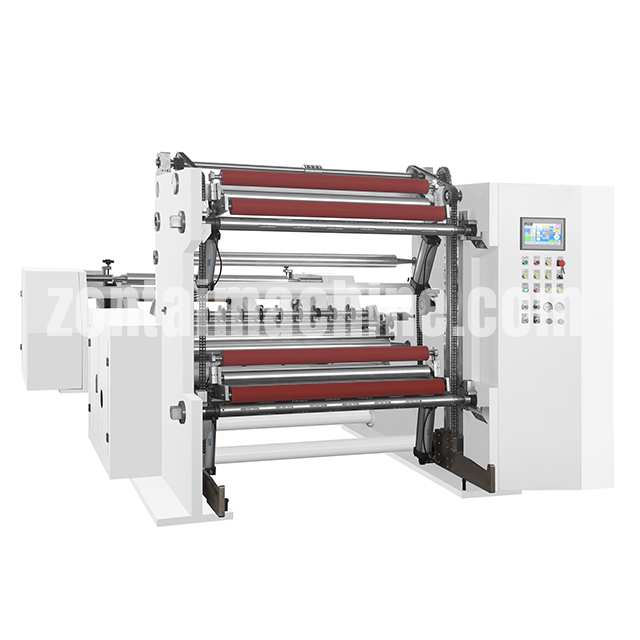
Handling massive parent rolls requires specialized equipment configurations. A jumbo paper roll slitting machine must manage immense inertia while maintaining microscopic cutting precision.
Blade material directly impacts wear resistance and edge retention. High-Speed Steel (HSS) blades offer a lower initial cost and are relatively easy to resharpen. They dull quickly when cutting abrasive paper grades. Tungsten Carbide blades cost significantly more upfront. They provide exceptional wear resistance, holding a sharp edge much longer during high-volume runs.
The blade profile also matters. A single bevel blade pushes the material to one side during the cut. A double bevel blade separates the material evenly. The choice depends on the paper's abrasive qualities and the desired slit width. Using the wrong profile increases friction, which generates excessive dust.
The cant angle is the slight toe-in angle of the top blade relative to the bottom anvil. Setting the correct cant angle—typically between 0.5 and 2 degrees—is critical. This angle ensures the blades only touch at a single point. It minimizes blade friction while ensuring a clean, scissor-like shear.
Knife overlap dictates how deeply the top blade intersects the bottom anvil. The tolerances for overlap are incredibly tight. If the overlap is too shallow, the blades will leave uncut fibers, creating a fuzzy edge. If the overlap is too deep, the top blade acts like a wedge. It plows through the paper, generating massive amounts of paper dust and accelerating blade wear.
Even perfectly calibrated shear slitting generates some microscopic dust. You must manage this dust at the source. Integrated dust extraction systems utilize localized vacuum nozzles positioned directly at the slitting point. These nozzles capture airborne particles the millisecond they separate from the web.
Removing dust immediately prevents particle buildup on the rewind rolls. If dust settles on the web, it gets trapped between the layers during winding. This trapped dust creates uneven roll profiles, surface defects, and edge telescoping. High-velocity vacuum systems maintain a clean cutting environment, protecting both the product and the machine components.
Specifying a new machine or upgrading existing equipment involves balancing capabilities against budget. You must guide your procurement decisions based on the long-term value a paper slitting rewinding machine brings to your operation.
Web speed and edge degradation share a non-linear relationship. As speed increases, aerodynamic drag on the web increases. The potential for vibration multiplies. Pushing a machine past its structural limits will immediately compromise cut quality.
Higher-end servo-driven machines maintain edge integrity at much higher speeds compared to mechanical-drive alternatives. Servo motors provide instantaneous tension adjustments, compensating for speed fluctuations. When calculating ROI, consider the cost of slower, higher-quality runs versus high-speed runs that produce higher rejection rates. A faster machine only provides value if the edge quality remains acceptable to your clients.
Automated Knife Positioning systems represent a significant upfront cost. They yield substantial long-term benefits. These systems use motorized carriages to position the top and bottom blades exactly to the required slit width.
Automation drastically reduces setup time between jobs. It eliminates human error in cant angle and side-load adjustment. The system ensures repeatable edge quality across multiple shifts, regardless of the operator's experience level.
Feature | Manual Setup | Automated Positioning |
|---|---|---|
Setup Time | 15 to 45 minutes depending on slit count. | Under 3 minutes for full repositioning. |
Cant Angle Accuracy | Relies on operator skill; prone to variance. | Digitally controlled; perfectly repeatable. |
Operator Safety | High risk of cuts during manual blade handling. | Zero contact required during width changes. |
Edge Consistency | Varies between shifts and operators. | Uniform quality across all production runs. |
Advanced machines now integrate predictive AI diagnostics. These systems utilize blade-vibration and heat sensors to monitor the cutting environment. The system forecasts blade degradation based on real-time data. It can automatically optimize cutting force or alert operators to change blades before edge quality drops below acceptable thresholds.
Post-installation, operational realities dictate your success. Maintaining edge quality requires strict adherence to maintenance protocols and continuous operator education.
Pushing blades past their optimal lifecycle is a common operational error. Dull blades do not cut; they tear. This tearing increases dust generation, causes frequent web breaks, and places a higher load on the machine's drive motors. The financial loss from rejected rolls far exceeds the cost of a new blade.
You must establish a predictive maintenance schedule. Do not base blade changes on arbitrary timeframes like "once a month." Track the linear footage cut by each blade set. Different paper grades wear blades at different rates. Monitor the cut quality closely and document the linear footage when degradation begins. Use this data to schedule proactive blade replacements.
Operator error frequently leads to poor edges. A common mistake is over-tensioning the web to compensate for a misalignment issue. While high tension might temporarily flatten a wrinkle, it stretches the paper and distorts the cut profile.
Your operators must master specific core competencies. They need to understand how to read load cell data and interpret web tension graphs on the HMI. They must recognize the auditory signs of blade chatter—a distinct high-pitched whining or buzzing sound. Training should focus on identifying the root cause of an edge defect rather than applying a temporary patch.
A clean edge is the result of a perfectly synchronized system. Rigid framing absorbs vibration, precise tension control stabilizes the web, exact blade geometry executes the shear, and real-time optical inspection verifies the result. A sharp knife alone cannot overcome a poorly tensioned or vibrating web.
When evaluating new equipment, procurement and engineering teams must prioritize specific capabilities. Look for vendors who offer closed-loop tension control, automated knife positioning, industrial-grade vision systems, and robust vibration dampening. These features are fundamental requirements for high-quality converting.
To move forward with your equipment selection, execute these next steps:
Audit your current blade lifecycle data to determine your true cost of edge degradation.
Compile a list of your most challenging paper grades, noting basis weights and abrasive qualities.
Conduct a material trial with shortlisted vendors using your specific parent roll samples.
Require vendors to demonstrate edge quality and measure dust generation at your target production speeds during the trial.
A: Dust is primarily caused by dull blades, incorrect cant angles, or using a crush cut method on inappropriate paper grades. These issues result in fractured and torn fibers rather than cleanly sheared ones. Excessive knife overlap also creates a plowing effect, generating significant particulate matter.
A: Frequency depends heavily on paper abrasiveness. Recycled grades and coated papers wear blades much faster than standard copy paper. You should recommend a replacement schedule based on continuous monitoring of cut quality and total linear footage processed, rather than relying on a fixed calendar date.
A: While the exact angle varies slightly by material thickness and blade diameter, a standard cant angle of 0.5° to 2° is typically required. This slight toe-in angle ensures the top and bottom blades engage cleanly at a single point without generating excessive friction.
A: Yes, retrofitting is highly effective. Common upgrades include swapping mechanical brakes for closed-loop tension controllers, upgrading to pneumatic knife holders for consistent side-load pressure, adding localized dust extraction systems, or mounting in-line quality inspection cameras to monitor the web.
A: Heavy parent rolls create significant inertia during unwind. Without precise, automated tension control, the web will flutter, sag, or stretch. This instability causes the paper to enter the slitting section at inconsistent angles, leading directly to jagged edges, web breaks, and uneven roll profiles.
A: Edge Position Control (EPC) uses sensors to track the physical outer edge of the paper web. Line Position Control (LPC) tracks a specific printed line or contrast pattern on the web's surface. Both systems shift the unwind stand to feed material perfectly straight into the cutting blades.
A: High-speed vision sensors continuously scan the cut edges as the web moves. They detect microscopic imperfections, fiber pull-out, and dust accumulation in real-time. This immediately alerts operators to correct tension imbalances or blade misalignments before the machine produces high volumes of waste.
