

Views: 0 Author: Site Editor Publish Time: 2026-06-03 Origin: Site


Evaluating industrial converting equipment requires looking far beyond basic specification sheets. You must understand how individual mechanical subsystems work together. They directly impact production yield, material waste, and operator safety. A poor alignment between machine components and your specific material properties inevitably leads to severe production issues. Rigid foils behave very differently than extensible films during the cutting process. If you mismatch these materials against the wrong web guiding or tension control system, you face constant web breaks, telescoping, and massive material waste.
This guide breaks down the core architecture of a modern converting system. We offer an evidence-based framework to help production engineers and plant managers audit OEM equipment. You will learn how to evaluate the critical modules, select the right cutting mechanisms, and shortlist the exact configuration needed for your operational scale. Proper selection guarantees higher machine uptime and consistent product quality.
System Synergy: A slitting rewinder relies on a continuous tension-control loop spanning three primary zones: the unwind stand, the slitting section, and the rewind unit.
Cutting Method Limitations: The choice between razor, score, and shear slitting dictates edge quality and throughput speed; mismatched blades will cause edge beading or excessive dust.
Rewind Mechanics: Selecting center, surface, or turret rewinding directly impacts roll density, susceptibility to telescoping, and shift-over-shift capacity.
Modernization & Compliance: Integrated PLCs, dynamic load cells, and interlocked safety enclosures are now baseline requirements for CE/OSHA compliance and minimizing operator-induced errors.
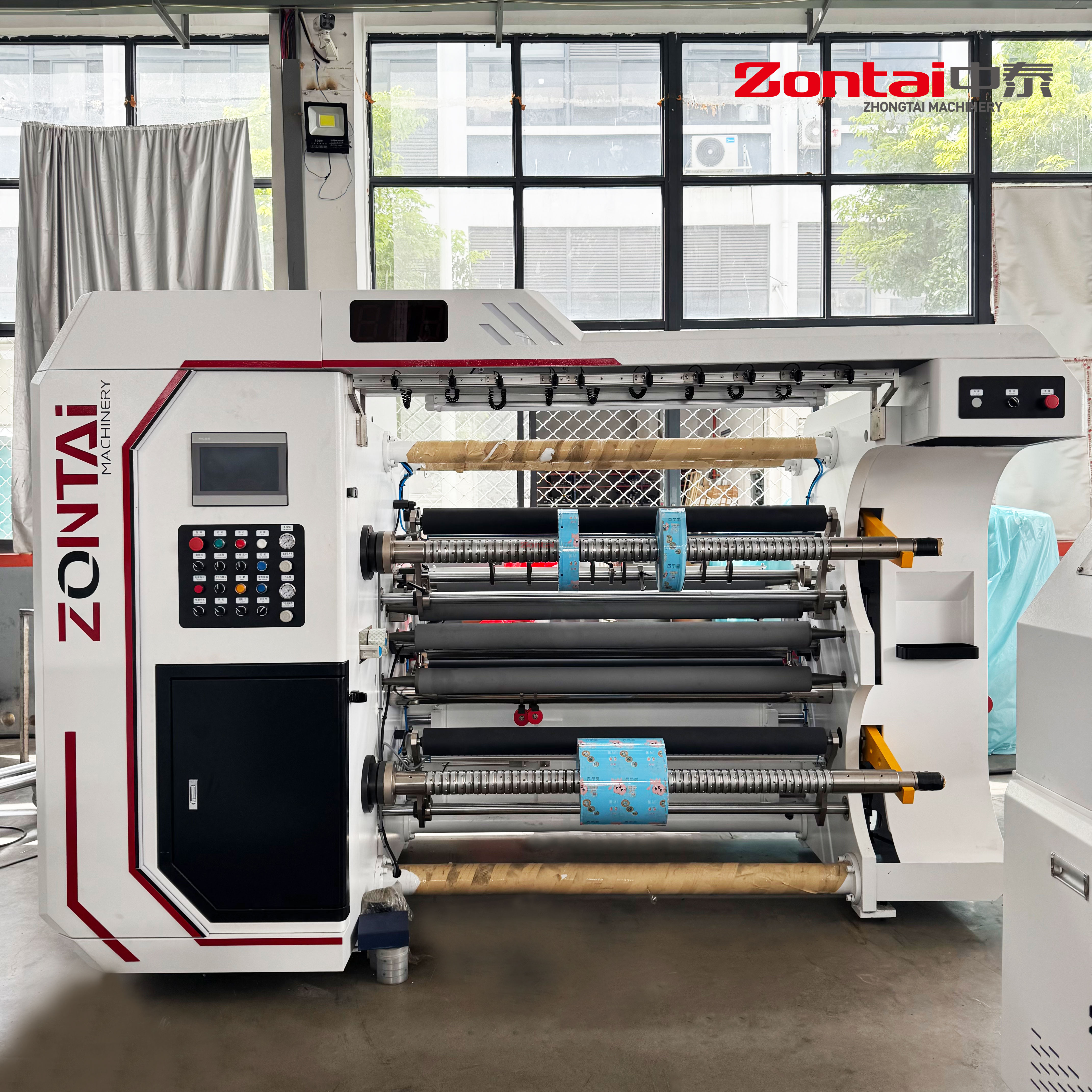
To standardize the evaluation of any OEM machine, you must map the equipment across its primary material flow stages. Each component demands strict scrutiny for structural rigidity and precision. When you evaluate a Slitting Rewinding Machine, understanding these five core modules ensures you make an informed technical decision.
The unwind stand secures the master roll and initiates the material web. Operators typically load these massive rolls using hydraulic or pneumatic expanding shafts. This section forms the foundation of your tension control loop. You should look for integrated load cells and automated braking systems. These components dynamically adjust tension as the master roll's diameter continuously decreases during the run.
This system ensures the material enters the cutting section perfectly straight. It prevents lateral drift, which would otherwise ruin your slit widths. High-end machines utilize ultrasonic or photoelectric edge sensors. These sensors connect to a fast-responding pivoting carriage. Floating rollers and closed-loop tension feedback remain critical here. They prevent web breaks when handling delicate substrates.
The slitting section acts as the heart of the machine. Here, knife shafts and blade assemblies shear the wide master web into narrower strips. You must assess the ease of knife positioning during changeovers. Manual setups drastically increase downtime between jobs. Automated auto-knife positioning systems solve this problem. They reduce setup time from hours to mere minutes.
Spreader sections sit immediately post-cut. Spreader rolls or separator discs prevent the newly slit strips from overlapping. If you skip this separation phase, the slit ribbons will interleave before they reach the rewind core. This interleaving creates a fused roll, destroying the final product.
The rewind stand receives the separated strips. It winds them onto new cores at a highly specific tension and density profile. The physical structure of this stand dictates your finished product quality.
Core Module | Primary Function | Key Evaluation Criteria |
|---|---|---|
Unwind Stand | Secures master roll; feeds material | Load cell integration; auto-braking response |
Web Guiding | Maintains straight material path | Ultrasonic/photoelectric sensors; pivot speed |
Slitting Section | Cuts wide web into narrow strips | Auto-knife positioning; tool rigidity |
Web Spreaders | Prevents strip interleaving | Adjustable bow rollers; smooth separator discs |
Rewind Stand | Forms the finished rolls | Torque control; tension tapering capabilities |
The slitting section does not follow a one-size-fits-all rule. Selecting the wrong cutting method introduces severe quality defects. These range from thermal degradation to rough edge fraying. You must align the blade mechanics directly with your material durometer and thickness.
Razor slitting uses stationary or oscillating blades. They slice directly through the moving web in open space or a grooved roll. This method proves highly economical and straightforward.
Best For: Thin, non-abrasive layers like standard polymer films (BOPP, PET) and light packing tapes.
Implementation Risks: At extremely high speeds, continuous blade friction generates intense heat. This heat can cause "beading" or melting on the edges of sensitive plastic films. Furthermore, you will need to replace the blades frequently to maintain a clean cut.
Score slitting utilizes a circular top blade. This blade presses the material against a hardened, rotating bottom anvil. The cutting action literally crushes the material apart.
Best For: Materials of varying stiffness, pressure-sensitive adhesives, and non-wovens. It handles thickness variations exceptionally well.
Implementation Risks: While versatile, the crushing action inherently generates microscopic dust. This makes score slitting highly problematic for clean-room medical environments or high-precision paper processing.
Shear slitting utilizes a robust two-part rotary knife system. It involves a male top blade and a female bottom blade. Together, they create a continuous scissor-like bite.
Best For: Thick films, metallic foils, heavy paper, and complex multi-layer laminates.
Implementation Risks: This method delivers the cleanest edge and highest dimensional precision. However, it requires the most complex mechanical setup. Operators must carefully calibrate the overspeed and blade cant angle to prevent rapid tool wear.
The mechanism used to rebuild the roll dictates the final product's physical profile. It affects roll density, edge straightness, and the machine's overall factory footprint. You must match the rewind configuration to your production volume demands.
Center rewinders drive the material directly through the central shaft. The machine creates tension through a controlled torque differential. As the roll diameter increases, the motor adjusts torque to maintain constant web tension.
This configuration is ideal for rigid, heavy, or sensitive materials. For example, BOPP tape requires incredibly tight winding tolerances. Center winding provides that precision. However, operators must manage tension parameters perfectly. If they do not, soft materials will inevitably suffer from telescoping. Telescoping occurs when lateral layers shift, ruining the roll's structural integrity.
In a surface friction setup, the rewind core rests directly against one or two large driven drums. The rotation occurs through physical surface contact rather than a driven center shaft.
Surface winding prevents air entrapment efficiently. It excels for soft, sensitive materials or massive rolls like heavy paper and non-wovens. Because the web tension does not rely on center torque, it inherently prevents telescoping. However, it lacks the absolute, dialed-in torque control found in advanced center winding systems.
Turret rewinders feature a massive rotating turret housing dual or multiple rewind stations. As one set of rolls reaches its target length, the turret rotates. It moves empty cores into the cutting path without stopping the machine.
This configuration maximizes throughput by achieving zero-downtime changeovers. It remains absolutely vital for high-volume, 24/7 continuous operations. While it requires significantly more floor space and robust structural foundations, the massive boost in machine uptime justifies the physical footprint.
Rewind Type | Mechanism | Ideal Material Application | Primary Limitation |
|---|---|---|---|
Center | Driven via central core shaft | Rigid films, foils, narrow tapes | Telescoping risk for soft webs |
Surface | Driven via contact with large drums | Paper, non-wovens, large diameters | Lower precision on tension tapers |
Turret | Rotating multi-shaft index system | High-volume continuous runs | Requires large operational footprint |
For decision-makers, evaluating the digital brain and safety housings of the machine holds immense importance. A robust mechanical frame means little without intelligent controls guiding it. You must demand modern automation standards.
Modern machines rely heavily on Programmable Logic Controllers (PLCs). They act as the central nervous system. A powerful PLC processes real-time feedback from load cells and encoder wheels. It uses this data to adjust motor speeds dynamically across all zones.
An intuitive Human-Machine Interface (HMI) screen pairs with the PLC. This touchscreen interface is critical for standardizing operator recipes. It reduces your factory's dependency on tribal knowledge. When an operator can load a pre-set tension profile for a specific film, human error plummets. Furthermore, smart HMIs accelerate fault diagnostics by pinpointing exactly which sensor tripped.
Advanced converting lines now integrate inline inspection systems just prior to the cutting phase. These optical cameras scan the moving web for pinholes, gels, or print defects. They identify material flaws early. This stops the processing of bad master rolls, minimizing downstream scrap and protecting your brand reputation.
You must never compromise on baseline safety infrastructure. Industrial converting machines handle immense kinetic energy and feature dangerous nip points. Ensure your chosen equipment includes:
Mandatory Emergency Stop Networks: Multiple E-stop buttons placed strategically around the perimeter.
Physical Guards: Hard barriers covering all exposed nip points and rotating drivetrain components.
Electrical Safety Interlocks: Intelligent switches that instantly kill motor power if an operator opens an access door during a live run.
Procurement teams must audit the expected lifespan of critical consumables to accurately model maintenance schedules. Understanding how and when parts degrade ensures you maintain high operational availability.
Blades and Knives: These serve as the primary consumable. You should clarify expected blade lifespan under your specific material durometer. Ensure standard, non-proprietary replacements are widely available in the market.
Knife Shafts and Tool Pockets: Over time, constant metal-on-metal micro-abrasions compromise the structural tolerance of the shafts. When shafts lose their micro-precision, your cutting width consistency degrades immediately. You will notice wavering edge profiles.
Guide and Pressure Rollers: Constant web friction steadily degrades roller surfaces. This happens especially quickly to rubberized, urethane, or cork-taped rollers. Aging, glazed rollers cause severe material slippage. This slippage directly leads to tension loss and wandering webs.
Drivetrain Components: Belts, timing chains, and high-speed bearings require rigorous, documented preventive maintenance schedules. If you neglect a bearing, it will introduce microscopic vibrations into the machine frame. These vibrations transfer directly to the cutting web, causing visible chatter marks on the finished roll.
Shortlisting the perfect converting equipment requires strict alignment between your daily material realities and the machine's core architecture. Start by defining your hard material constraints. Your web's thickness, abrasiveness, and extensibility dictate whether you need razor, score, or shear slitting. Next, let your production volume and shift capacity dictate the rewind configuration.
Always verify the machine's safety compliance and automation capabilities. Intelligent PLCs and automated knife positioning save thousands of hours in annual setup time. Finally, demand transparent data regarding the maintenance cycles of wearing parts. Prioritizing robust mechanical design over superficial features guarantees a stable, highly productive converting line for years to come.
A: Speed capabilities vary drastically by material and machine type. Narrow-web film machines typically run between 100 to 300 meters per minute. High-end duplex machines can comfortably reach 300 to 500 meters per minute. Meanwhile, heavy-duty, two-drum surface rewinders designed for the paper industry can frequently exceed operating speeds of 1,500 meters per minute.
A: Depending on the specific tooling and rewind setup, high-precision center winders can typically cut down to 25mm (1 inch) widths reliably. Specialized center-surface winders or dedicated spooling machines can achieve extreme narrow cuts down to 6mm (1/4 inch) for niche applications.
A: The "web" refers to the continuous, flexible roll of material. This can be plastic film, paper, aluminum foil, or textile. The term applies as the material unwounds, processes through the tension zones, and navigates through the machine's guiding systems.
A: Telescoping happens when the layers of a rolled material slide laterally, resembling a collapsed telescope. This critical roll defect is typically caused by improper tension control loops, misaligned guide rollers, or utilizing a center-rewind setup for overly soft and pliable materials.
