

Views: 0 Author: Site Editor Publish Time: 2026-08-20 Origin: Site


In high-speed flexible packaging, print quality means nothing if the final roll fails on downstream slitting or packaging lines due to poor web handling. Uncontrolled rewinding causes web stretching, telescoping, starring, and undetected registration errors. These mechanical failures compound material waste, trigger customer rejections, and bottleneck production schedules across the plant floor. Selecting the right rewinding equipment requires looking past basic speed metrics. You must evaluate closed-loop tension control, automated defect inspection, and material-specific handling capabilities. This guide breaks down the technical criteria for evaluating rewinding solutions, ensuring you implement a printing film rewinding machine that stabilizes your production workflow.
Tension Control is Non-Negotiable: Precise, closed-loop tension management prevents gauge bands and telescoping, particularly for heat-sensitive or highly extensible substrates like PE and BOPP.
Inspection Integration Drives ROI: Transitioning to an automatic inspecting rewinding machine reduces downstream waste by isolating print defects before they reach the slitter or end-user.
Static and Dust Management Ensure Product Purity: Active static neutralization and dust extraction are critical to prevent contamination on food-grade and medical films.
Material Versatility Dictates Machine Architecture: Drive systems, nip roller configurations, and edge guiding mechanisms must be matched to the specific micron thickness and slip characteristics of the facility's film portfolio.
The primary function of a rewinder extends far beyond simply transferring material from one core to another. It acts as a critical corrective stage, rectifying upstream web profile issues and verifying print integrity before the roll moves to finishing. A poorly wound roll disrupts every subsequent process. When tension is mismanaged, mechanical realities like telescoping, starring, and dishing manifest on the rewind shaft. Telescoping occurs when lateral shifting creates a cone-like roll edge, making it impossible to mount securely on downstream equipment. Starring indicates internal stress fractures within the roll, usually caused by winding the outer layers tighter than the inner layers, which crushes the core and distorts the film.
These uneven tension profiles cause catastrophic web breaks on high-speed Vertical Form Fill Seal (VFFS) and Horizontal Form Fill Seal (HFFS) machines. When a roll has inconsistent tension, the packaging machine's dancer rollers cannot compensate fast enough. This leads to snapped webs, ruined product, and extended downtime on the packaging line. Operational success requires establishing strict baseline metrics for your web handling.
Tension Variance Limits: You must evaluate acceptable variance in web tension, typically measured in Pounds per Linear Inch (PLI) or Newtons per meter (N/m). For extensible films like LDPE, tension must be kept extremely low and consistent to prevent necking.
Edge Alignment Tolerances: Edge alignment should remain within ±0.5 mm to ±1.0 mm, depending on the demands of the downstream slitter.
Speed Stability: The equipment must maintain these tolerances at maximum operational speeds without any degradation in tension stability or edge guiding accuracy.
Operators on the floor know that a master roll coming off the press is rarely perfect. Gauge bands—areas where the film is slightly thicker due to extrusion variances or heavy ink coverage—create localized high-tension zones. A high-performance rewinder must isolate these zones and distribute the tension evenly across the web width before the material is wound onto the final core.
Modern rewinding equipment relies on a synthesis of mechanical and electronic systems. The efficacy of a film roll rewinding machine depends heavily on its closed-loop tension control system. Load cells measure the actual tension across the web, sending real-time data to the Programmable Logic Controller (PLC). The PLC then adjusts the torque on the rewind shaft servo motors. Dancer rollers provide physical buffering, absorbing sudden tension spikes caused by out-of-round unwind rolls. Together, these components maintain a taper tension profile, gradually decreasing winding tension as the roll diameter increases to prevent starring and core crushing.
Rewind shaft configurations directly impact roll quality. Standard air expanding shafts are sufficient for uniform, thick materials. However, differential friction shafts are mandatory for films with thickness variations. Differential shafts utilize individual friction rings that slip independently. This mechanical slip compensates for gauge bands across the web width, ensuring that thinner lanes do not wind loosely while thicker lanes wind too tightly.
Guiding System | Sensor Technology | Best Application |
|---|---|---|
Edge Position Control (EPC) | Ultrasonic | Transparent films (e.g., clear BOPP, CPP) where optical sensors fail to detect the edge. |
Edge Position Control (EPC) | Infrared / Optical | Opaque, printed, or metallized films with a distinct, high-contrast edge. |
Line Position Control (LPC) | CCD Camera | Tracking a specific printed line or pattern rather than the physical edge of the web. |
Drive technology has shifted from asynchronous AC drives to independent servo-driven systems. Servo motors on the unwind, nip, and rewind stations provide precise speed synchronization. This eliminates the micro-slippage that causes scratching on delicate coatings or cold-seal adhesives. Furthermore, high-speed friction generates dangerous electrostatic charges. Active ionizing bars neutralize these charges, while dust extraction hoods remove particulate matter. This is absolutely critical to prevent contaminant attraction on optical-grade and food-contact films.
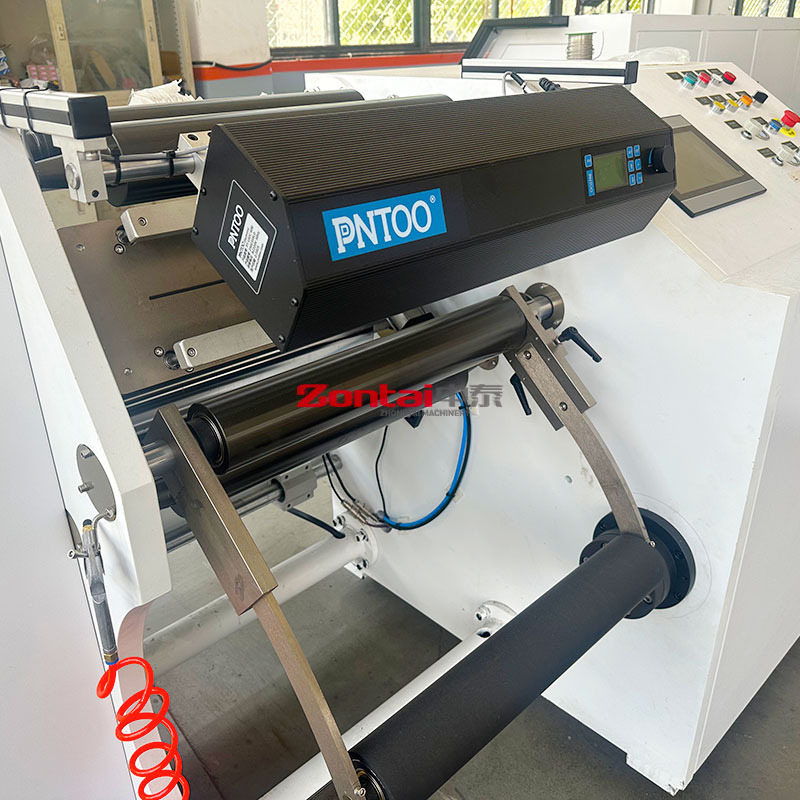
Mapping inspection capabilities directly to waste reduction mandates transforms the rewinder into a strict quality assurance checkpoint. An automatic inspecting rewinding machine utilizes high-resolution line-scan cameras and synchronized strobe lighting to achieve 100% print defect detection. These vision systems identify misregistration, color variations, hickeys, doctor blade streaks, and missing text at velocities exceeding 400 meters per minute.
When the system identifies a defect, the mechanical sequence must be flawless to maintain production efficiency. The machine executes a precise series of actions:
Detection and Flagging: The vision system logs the exact encoder position of the defect.
Controlled Deceleration: The PLC ramps down the servo drives, maintaining web tension to prevent slack.
Precision Stopping: The machine stops with the exact defect location positioned directly on the splicing table.
Web Clamping: Pneumatic clamps secure the film on both sides of the splice table to maintain tension during the cut.
Removal and Splicing: The operator uses integrated cutting guides to remove the flawed section and tapes the clean web back together.
Facilities manage flagged defects through various remediation methods if they choose not to stop the machine immediately. Inkjet line-markers can spray a physical mark on the roll edge, or paper tab inserters can flag the exact location. Advanced operations utilize digital roll-mapping software. This software creates a digital twin of the roll's defect locations, which is then fed directly into the downstream slitter to automate the removal process. Flaw mapping and audit trails provide necessary data logging and compliance reporting, particularly for pharmaceutical or food-grade flexible packaging requiring strict traceability.
Matching machine specifications to current and future production demands requires analyzing material compatibility. A versatile roll to roll rewinding machine must handle varying substrates, from highly extensible thin LDPE to rigid PET laminates. Specialized nip roller coatings, such as silicone, cork, or grooved rubber, prevent scratching, slipping, or air trapping during the winding process. Maintaining tension and inspection accuracy becomes exponentially more difficult at high speeds. Engineering trade-offs exist between maximum velocity and the precision of defect detection.
Roll diameter and weight capacities dictate the structural frame of the machine. Facilities must choose between cantilevered and shaftless designs based on their master roll specifications. Cantilevered designs support the shaft from one side, allowing operators to slide rolls on and off quickly. This works well for narrower webs and lighter rolls. Shaftless floor-pickup systems use hydraulic or pneumatic arms to grab the core directly from the floor, eliminating the need for overhead cranes when handling multi-ton master rolls.
For sanitary environments, GMP and cleanroom compliance dictate structural design. Equipment must feature stainless steel cladding, paint-free product zones, and non-shedding belt systems to prevent particulate generation. The routing of pneumatic lines and electrical cables must be enclosed to allow for easy washdown and wipe-down procedures. You cannot run medical-grade Tyvek or food-contact films on a machine that sheds dust from its brake pads or drive belts.
Balancing operational efficiencies against potential bottlenecks is crucial for successful implementation. The primary value driver is waste reduction. By isolating defects early, facilities reduce scrap rates at the slitter, minimize customer returns, and increase overall downstream uptime. However, implementation carries operational risks, heavily dependent on operator interaction and maintenance protocols.
Overly complex Human-Machine Interfaces (HMIs) pose a significant threat to operational success. Sophisticated tension algorithms and automated inspection parameters are useless if operators bypass them due to poor usability or a lack of training. The interface must be intuitive, allowing operators to input material profiles and tension curves without requiring an engineering degree. Training programs must focus on understanding the mechanics behind taper tension and defect mapping, not just memorizing button sequences.
Maintenance strategies and spare parts availability mitigate prolonged downtime. Equipment should utilize standard, non-proprietary electronic components. Specifying standard PLCs and servo drives prevents vendor lock-in. When a component fails, maintenance teams can source replacements locally rather than waiting for proprietary parts to ship internationally. Regular calibration of load cells, edge sensors, and vision cameras ensures the system maintains its baseline accuracy over years of continuous operation. Neglecting load cell calibration will result in tension drift, slowly degrading roll quality over time without triggering obvious alarms.
Audit your current production runs to identify the specific substrates causing the highest rate of downstream web breaks or telescoping.
Draft a User Requirement Specification (URS) that clearly defines your maximum web widths, required tension ranges, and minimum defect detection sizes.
Request physical demonstrations from equipment manufacturers using your own printed master rolls to verify tension stability and splicing table ergonomics.
Standardize your electronic components by specifying preferred PLC and servo drive brands to simplify future maintenance and spare parts inventory.
A: A slitter rewinder cuts a wide master roll into multiple narrower rolls using rotary knives or razor blades. A printing film rewinding machine typically unwinds and rewinds a single roll without slitting, focusing primarily on correcting tension profiles, aligning edges, and inspecting for print defects.
A: It uses high-resolution line-scan cameras to detect flaws. Upon detection, the machine automatically decelerates, tracks the defect via encoders, and stops the exact flawed section on a splicing table. The operator then cuts out the defect and splices the clean web back together.
A: Telescoping is caused by misaligned web guiding, inconsistent tension, or a slippery film surface causing layers to slide laterally. It is prevented by using precise Edge Position Control (EPC) systems, closed-loop tension control, and applying the correct taper tension profile during rewinding.
A: Taper tension is the gradual reduction of winding tension as the roll diameter increases. It is critical because winding a roll with constant high tension causes the outer layers to crush the inner layers, leading to starring, material stretching, and core collapse.
A: Closed-loop systems use load cells to measure actual web tension continuously. This data is sent to a PLC, which instantly compares it to the target tension setpoint. The PLC then adjusts the torque of the servo motors to correct any deviations in real-time.
A: High-speed unwinding and rewinding generate severe friction, creating electrostatic charges on the film. If not eliminated using active ionizing bars, this static attracts ambient dust and contaminants, which ruins food-grade or medical packaging and can cause dangerous shocks to operators.
A: Specify differential friction shafts when running films with inconsistent thickness profiles or gauge bands. The independent friction rings slip to compensate for thickness variations, ensuring every section of the web winds with uniform tension, preventing loose lanes and hard spots.
